

There we are at Yaroslavl Terminal Station, in Moscow, ready for the moment we were both waiting for: the departure. It is not our first departure, but this is certainly going to be the hardest of our trips, not only due to the length and several kilometers, but also due to intensity that we are going out visit the main Russian cities in a very short time, managing many several timetables and transports in a country where unpredictability is something take into account. We are at kilometer zero and precisely 9.288 kilometers to our destination. Although we are focused, we smile, understanding the importance of trips for us.
Carrying our backpacks, and after verifying several times our first ticket, we approach our carriage. Many people are passing us with their big suitcases and belongings, moving on the platform like little ants, with the goal to enter in the train as soon as possible. Me and Andreja let ourselves to stay behind and therefore we can enjoy the moment and also the marvelous sunset, disappearing on the horizon, like the sun is falling on the railways (first photo).
In Russia, tickets are verified two times, one of the them at the entrance of the train. Conductors are therefore at the door of the carriage they supervise. When showing the tickets comes the first problem: we are not on the passengers' list. It is not possible! We have done the online check-in, thus, we have to be on it. The lady looks many times times at our passports and tickets, which are printed on A4 sheets, and she does not understand what is going on. How could this happen? Are we going to miss the first train and our trip ends here? Facing this dead-lock, Andreja has a good idea: to show the tickets we have just printed from the machines. The conductor smiles ironically: "Why you did not show these tickets before? Now it is clear what happened: we made the check-in online previously, but we have annulled it by printing new tickets. Solved the problem, we enter.
We easily find our seats and we put the bags under Andreja's bed. The experience aboard of Russian trains has shown us that this is the best strategy. By occupying a lower bed we would be sure that our belongings are safe, since there are some cases of thefts in the trains. This happen when people go to the toilet, restaurant, or even outside, during the several stops till Vladivostok, which can last from only 5 minutes to around 1 hour, therefore used not only for passenger boarding, but also making it possible for the ones already installed to stretch their legs and take fresh air. On the other hand, by taking the upper bed, right above the other, we avoid that a stranger can sit on the lower bed during the day.
The conductor announces the closing of the doors, and so the train starts moving on the tracks that guide us to the unknown. She comes to check the tickets and give us the set of sheets, pillow case and towel, additional services paid in exchange of 105 rubles (roughly 2,50 euro). Without this supplement, it is not allowed to use the mattresses, unless we have a sleeping bag.
Andreja goes to the toilet to change her clothes and I wait for her, preparing my bed. On my place there is a strange object. From the first sight it looks like a simple handle from a travel bag and, thinking this way, I take this aparently useless piece of textile and I put it in the trash next to the WC. Meanwhile, Andreja comes back and we talk. Suddenly, I notice other "handles" hanging on upper beds and I finally realize their utility: anti-fall protection, avoiding people to fall from their respective beds (second picture). This was a new situation for me, since, in all the trains I traveled, this anti-fall protection was done by retractable metal bars. Thus, I see myself obliged, and also ashamed, under the laughs of people observing me, to go to trash and take back that little thing that I have thrown away. For sure the other passengers thought how idiots these foreign tourists can be...
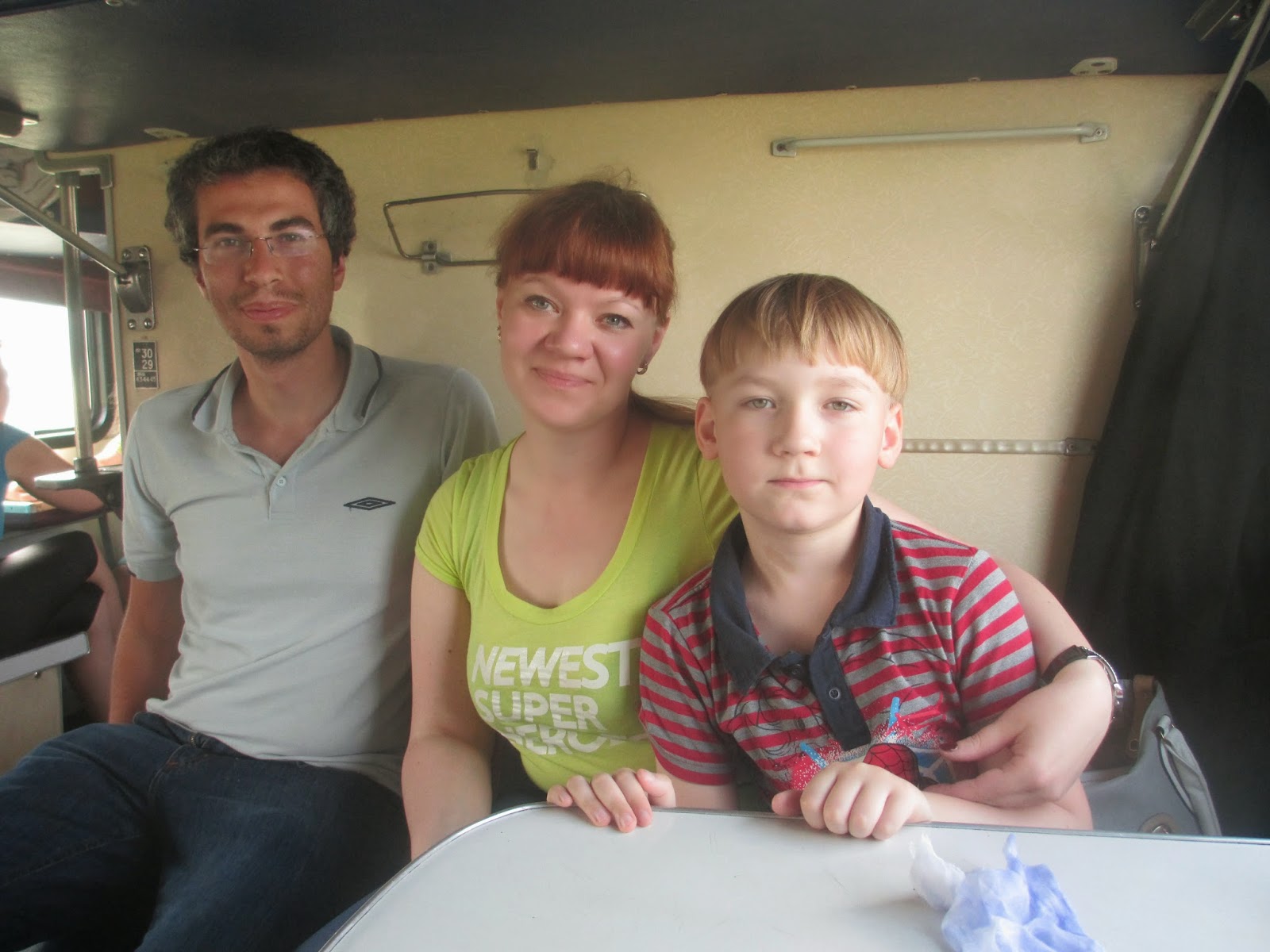
On our side, there are Marina and little Pasha, mother and son (third photo). At the beginning they are bit afraid, speaking to us only few words in english, but then they quickly realize that we are able to speak fluently Russian and we start a conversation. They are from Yekaterinburg and they are traveling around European Russia. These are going to be our neighbors till our stop in Perm. Lights are switched off and it is time to sleep.
Aqui estamos nós na Estação Terminal de Iarosvlavl, em Moscovo, ambos prontos para o momento que tanto ansiávamos: a partida. Não é a nossa primeira partida, mas esta será certamente a mais exigente das nossas viagens, não só pela duração e quilometragem, mas igualmente pela intensidade com que vamos tentar percorrer as principais cidades russas num curto espaço de tempo, conciliando vários horários e transportes, isto num país onde a imprevisibilidade é um factor a ter conta. Estamos no quilómetro zero e a precisamente 9.288 quilómetros do nosso destino. Estamos concentrados, mas não deixamos de sorrir ao perceber a importância desta viagem para nós.
De mochila às costas e, após verificar várias vezes o nosso primeiro bilhete, encaminhamo-nos para a nossa carruagem. Por nós passam diversas pessoas atarefadas com os seus malões e pertences, percorrendo a plataforma como que formiguinhas, com o objectivo de entrar o mais cedo possível para o comboio. Eu e a Andreja deixamo-nos ficar para trás e aproveitamos para desfrutar do momento e do magnífico pôr-do-sol que se perde no horizonte, como se o sol estivesse a cair sobre a linha do comboio (primeira foto).
Na Rússia, os bilhetes são verificados duas vezes, uma delas à entrada do comboio. As revisoras encontram-se assim à porta das carruagens que supervisionam. Chegado o momento de apresentar o bilhete vem a primeira contrariedade: não estamos na lista de passageiros. Não pode ser! Nós efectuámos o check-in online, por isso, temos de estar nela. A revisora olha várias vezes para os nossos passaportes e bilhetes impressos em folhas A4, sem perceber o que se está a passar. Mas como pode isto nos acontecer? Será que vamos perder logo o primeiro comboio e a nossa viagem fica por aqui? Perante o impasse, a Andreja tem uma boa ideia: mostrar os outros bilhetes que tínhamos acabado de imprimir nas máquinas. A revisora sorri e diz-nos num tom trocista: "Porque não mostraram estes bilhetes antes?" Agora é perceptível o que se tinha passado: tínhamos feito previamente o check-in online, contudo tinhamo-lo anulado com a impressão de novos bilhetes. Resolvido o problema, entramos.
Encontramos facilmente os nossos lugares e colocamos as mochilas debaixo da cama que estava destinada à Andreja. A nossa experiência a bordo de comboios russos mostrou-nos que essa seria a melhor estratégia. Ocupando uma cama inferior ficaríamos com a certeza de que os nossos pertences estariam seguros, pois existem alguns casos de roubos nos comboios. Isto acontece aquando de deslocações à casa de banho, restaurante, ou mesmo ao exterior, durante as muitas paragens até Vladivostoque, que podem durar entre 5 minutos a cerca de 1 hora, servindo não só para embarque de desembarque de passageiros, mas igualmente para quem já está instalado poder desentorpecer as pernas e apanhar ar. Por outro lado, ao escolhermos uma cama superior, sendo esta por cima da outra, invalidamos as contrariedades do ocupante dessa cama ser um desconhecido e querer sentar-se na cama inferior durante o dia.
Após o grito da revisora, sinalizando o fecho das portas, o comboio inicia a sua marcha nos caminhos-de-ferros que nos guiam rumo ao desconhecido. A revisora chega para conferir os bilhetes e dar-nos o conjunto de lençóis, fronha e toalha, serviço adicional pago mediante a quantia de 105 rublos (sensivelmente 2,50 euros). Sem esse suplemento, não é permitido o uso dos colchões, a não ser que disponhamos de sacos-cama.
A Andreja vai à casa de banho para trocar de roupa e eu fico à espera, preparando a minha cama. No meu lugar está um objecto estranho. À primeira vista parece-me uma simples pega de um saco de viagem e, julgando dessa forma, pego nessa tira de tecido aparentemente sem utilidade e ponha-a no lixo, junto ao WC. Entretanto a Andreja volta e conversamos. De repente, reparo em outras "pegas" em cada cama superior e entendo finalmente a utilidade das mesmas: protecção anti-queda, evitando que as pessoas caiam das camas respectivas (segunda foto). Esta foi uma situação nova para mim, pois em todos comboios onde viajei, essa protecção anti-queda era feita por barras de metal articuláveis. Logo, vejo-me obrigado, com alguma vergonha e, debaixo dos risos das pessoas que me observavam, a ir buscar ao lixo aquela coisa esquisita que tinha jogado fora. De certeza que pensavam o quão idiotas os turistas estrangeiros podem ser...
Ao nosso lado, estão a Marina e o pequeno Pacha, mãe e filho (terceira foto). De início ficam receosos, a falar connosco algumas palavras em inglês, mas depois percebem que falamos russo fluente e desenvolve-se a conversa. mãe e filho São de Iecaterimburgo e encontram-se fazer uma viagem pela Rússia europeia. Estes serão os nossos vizinhos até à nossa paragem em Perm. As luzes apagam-se e é tempo de dormir.


